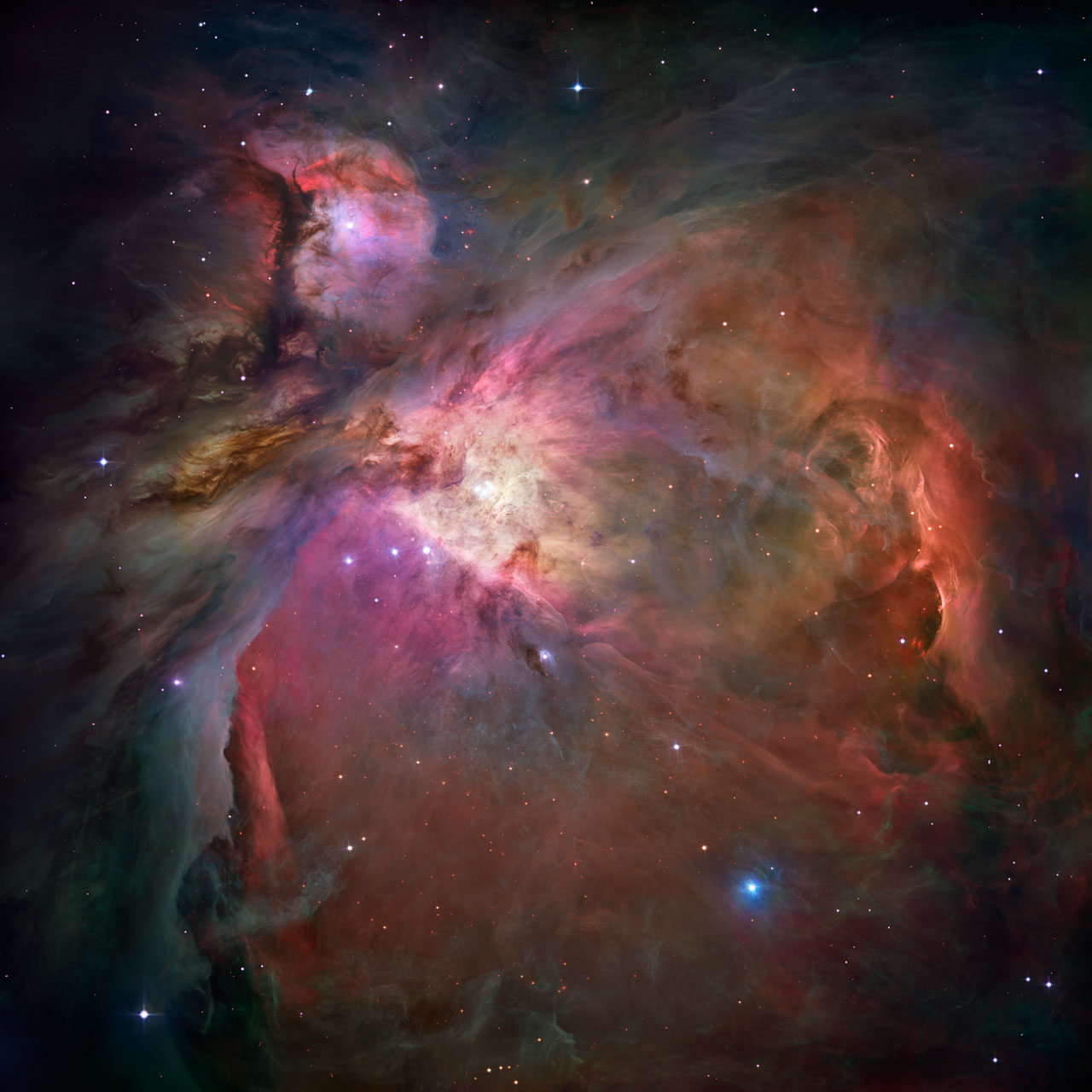
Hubble view of the Orion Nebula, with glowing pink and orange clouds of gas and dust surrounding thousands of stars

A FIELD GUIDE TO THE UNIVERSE

Look up.
Wonder more.

From our planetary neighborhood to the edges of what we know. Explore space, follow the evidence, and bring your biggest questions.

Explore the universe
01 / THE BIG PICTURECuriosity is a good place to start.

START CLOSE. GO FURTHER.

A universe worth
getting to know.

Space is more than a beautiful view. It’s a way to understand where we are—and how we got here.

01

OUR NEIGHBORHOOD

The solar system

Eight planets orbit our star, the Sun. Rocky worlds fill the inner solar system; giant planets lie farther out. Moons, asteroids, and comets add their own stories.

8planets, one shared star
Why isn’t Pluto a planet?

Pluto is classified as a dwarf planet. It orbits the Sun and is nearly round, but it has not cleared its orbital neighborhood of other objects.

02

BEYOND OUR STAR

Stars & galaxies

Stars produce energy through nuclear fusion. Gravity gathers stars, gas, dust, and dark matter into galaxies. Our Sun is one star in the Milky Way.

Light-yeara distance, not a measure of time
Are we looking into the past?

Yes. Light takes time to reach us, so we see distant objects as they were when their light began its journey. Farther away means farther back in time.

03

AT THE LIMITS

Black holes

A black hole is a region where gravity is so strong that light cannot escape beyond its event horizon. We study its effects on nearby matter and light.

Event horizonthe boundary of no return
Do black holes pull in everything?

No. At a distance, their gravity behaves like that of other objects with the same mass. Objects can orbit a black hole without falling in.
HOW WE KNOW

Wonder starts it.
Evidence moves it forward.

Telescopes collect light. Spacecraft explore worlds. Scientists test explanations against observations—and revise them when new evidence arrives.

Discover why we do this

YOUR TURN TO WONDER

No question
is too cosmic.

What have you always wanted to know about space? Send a question about planets, stars, galaxies, black holes, or anything beyond Earth.

Questions are saved for this science project. An answer or reply isn’t guaranteed.

10–2,000 characters. Please leave out private information.

Learn more from NASA’s solar system guide and NASA’s universe guide. Orion Nebula: NASA, ESA, Hubble Space Telescope Orion Treasury Project Team, Massimo Robberto (STScI, ESA).